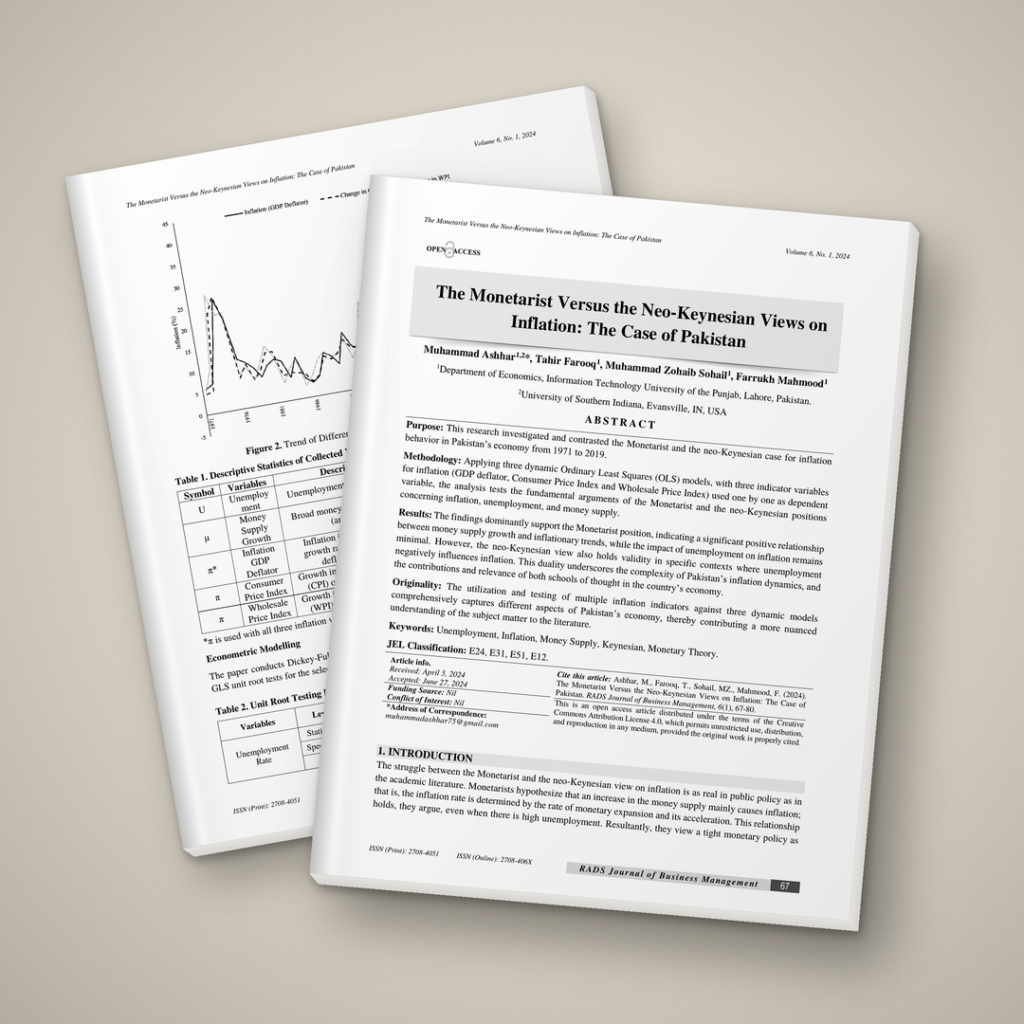
Economists disagree about what causes inflation. Monetarists say it mainly depends on how fast the money supply grows. Neo-Keynesians say the state of the economy matters more, especially unemployment, with inflation rising as joblessness falls.
This debate matters for Pakistan, as the State Bank gained independence and is moving toward inflation targeting. This paper tests both views using Pakistani data from 1971 to 2019. Earlier studies have usually relied on a single measure of inflation. We used three: the GDP deflator (overall prices), the Consumer Price Index (prices consumers pay), and the Wholesale Price Index (prices at the producer level).
The paper runs each inflation indicator through three econometric models, giving nine tests in total and reducing the risk that results depend on one particular setup. Most of the results support the monetarist view. Faster money supply growth is linked to higher inflation, and unemployment has little effect in most specifications.
The neo-Keynesian view isn’t ruled out, though. When inflation is measured with the GDP deflator, unemployment shows an inverse link with inflation.
The paper concludes that Pakistan’s inflation doesn’t fit neatly into either school, and argues for a flexible, hybrid policy approach: control the money supply, but don’t ignore labor market conditions.
Paper published in RADS Journal of Business Management, Vol. 6(1), 2024, pp. 67–80: https://jbm.juw.edu.pk/index.php/jbm/article/view/160