
The natural life of a business is about 20 to 25 years, based on ideational strength of a business, proactive life profile of the founder, technological changes, and demand patterns or demography. Years and decades are important time durations during any business struggle. The strategic renewal of a business after a decade gives it the strength to complete its natural life successfully. After the completion of her natural life, a business disintegrates or takes on a new shape for the next period of life through a new generation of entrepreneurs. During her natural life, generally, a business passes through four phases: infant or initial phase, young or middle or struggle phase, mature or growing phase, and stable or final or renewal phase.
Growth has a shape
Ask a founder to sketch the next twenty years of their business and you will usually get a line going up. Sometimes it bends a little. But the drawing would rarely break. The sketch is optimistic in a specific way. It assumes that what works now will keep working, and that the job is to do more of it.
Businesses tend to move through phases, and each phase behaves differently from the last. The framework set out here covers four of them across roughly twelve years: launch, struggle, growth, renewal. Timelines may vary by industry and market, but it is useful to look at the transitions. Trouble tends to arrive at the handover between phases.
The idea that a business has a life cycle is not new. Theodore Levitt gave it its standard form in the Harvard Business Review in 1965, arguing that products pass through introduction, growth, maturity and decline, and that managers should plan for each stage instead of reacting to it. In this model, decline is treated as the natural end of a curve that has run its course.
We keep Levitt’s first three stages and contest the fourth. Our four-phase growth trajectory of a business is visualised in Figure 1.
Figure 1. Four-phase growth trajectory of a business.
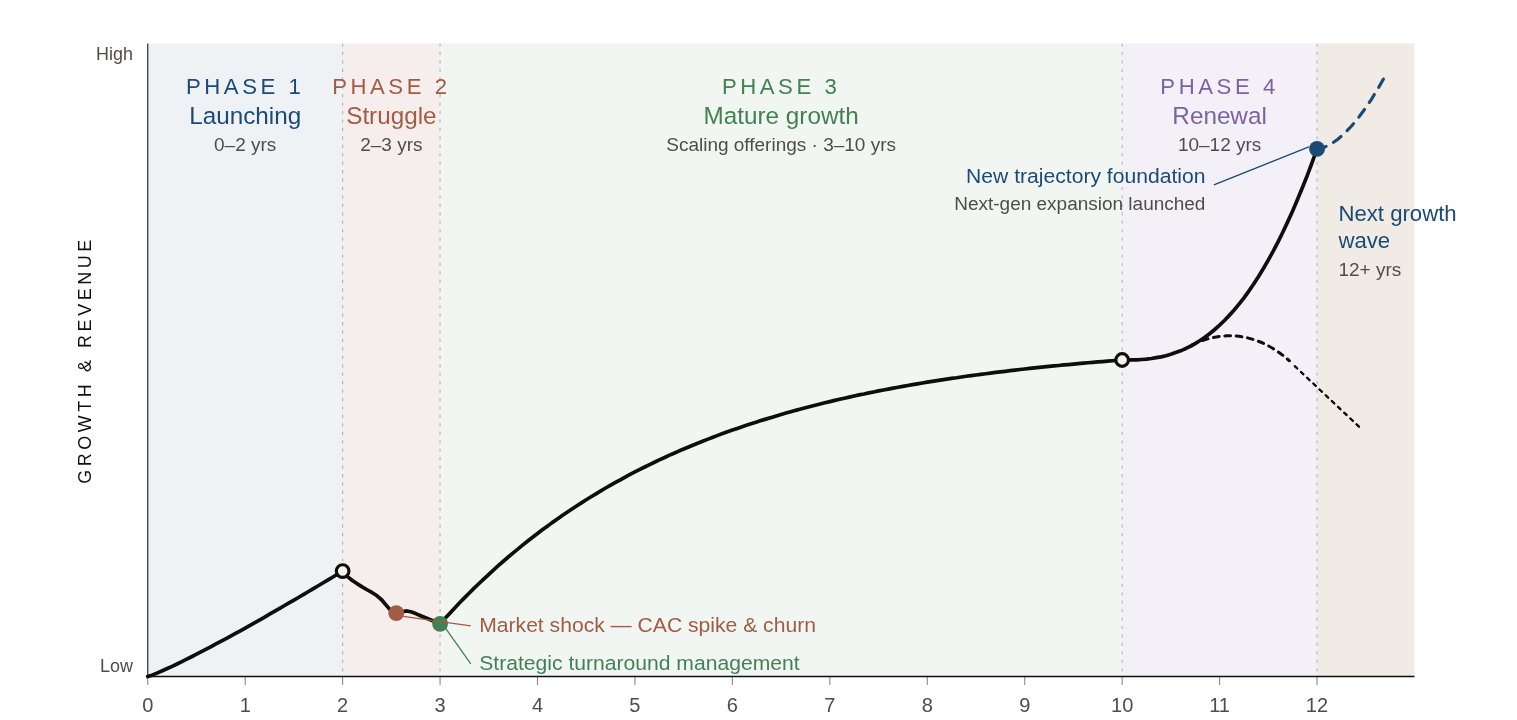
Phase one: Launching (years 0–2)
The early years are the most linear a business will likely experience. Growth from a base of zero can look spectacular in percentage terms, but small in absolute terms.
The work in this phase is building. Getting a first version out. Finding the first hundred paying customers. Learning what people actually use the product for. These are the tasks most founders are good at, enjoy, and started the business to do.
The characteristic error of this phase is reading motion as progress. Spending approaches (or outpaces) revenue, and that gets tolerated because customers are arriving. But early customers are often won one at a time, by founders. That proves the founder can sell. It does not prove the business can.
Phase two: The struggle (years 2–3)
Then the arithmetic changes. The early adopters have been signed. The next customer costs more to acquire than the last. Churn or sales slumps begin to show up in the reports. Sometimes the trouble comes from outside; a platform revises its terms, a regulator moves, a client worth a quarter of revenue leaves.
US Bureau of Labor Statistics data, which tracks private-sector establishments from the year they open, shows that of those that started in 2013, about 80% were operational after one year, roughly 50% after year five, and only 30% after year twelve. The pattern is largely the same across cohorts going back to 1994.
The first year is the most dangerous, and each year survived improves the odds of surviving the next. But attrition doesn’t stop once a business has found its feet. Between the second and fifth year, about half of the original cohort disappears.
This phase calls for diagnosis rather than construction. Which customers renew, and what do they have in common? Which services lose money once all costs are considered? What should the business stop selling altogether?
Recovery can be an act of subtraction. Cut what bleeds. Re-price. Narrow to a segment that can be defended. Convert lumpy project work into something recurring. It is difficult because it means telling people (clients, colleagues, sometimes yourself) that something you built isn’t working.
The skills that carry a business through its first two years are not the skills that carry it through the third and so on.
Phase three: Mature growth (years 3–10)
Upon surviving the struggle, the business enters a longer stretch where earlier work starts paying for itself. Customers begin arriving. Systems do what used to require somebody staying late. Margins hold. The curve climbs, then eases into an “S”.
What the business needs now is a different sort of person in charge, or the same person doing a noticeably different job. The work shifts from making things to building the conditions in which other people make things: hiring, delegation, process, financial control, and the structural work of an organisation that runs when its founder is away.
The risk in this phase is easy to miss, because nothing appears to be wrong. Seven profitable years can teach an organisation that its model works, and the lesson is true right up until it isn’t. Firms get very good at the thing they do, which is another way of saying they get worse at doing anything else.
Phase four: Renewal (years 10–12)
By year ten, the original advantage usually thins. Technology dates. Competitors copy what took years to work out. Others notice the market gap that made the business possible. Levitt’s model calls what follows decline. It becomes decline only if nothing else has been started.
Charles Handy introduced the alternative in 1994 in The Empty Raincoat: Making Sense of the Future. Every successful system, Handy argued, traces an S-shaped curve: a slow, faltering start, a strong rise, and eventually a fall. Growth continues only where a second curve is begun out of the first. His difficult point concerns timing: the second curve has to start before the first one peaks, at a point where nothing in the numbers suggests any change is needed.
Renewal becomes visible in the numbers somewhere in years ten to twelve. The decision that produces it has to be taken before that, in the middle of phase three, while the growth curve is still climbing and nobody in the room is worried.
What renewal looks like in practice can vary: a new product line, entry into another market, rebuilding a technical foundation that has grown expensive to maintain, or spinning out a venture the core business cannot house. What they share is discomfort. Each means spending the profits of something that works on something that does not work yet.
The competences involved belong to ownership rather than operation: allocating capital, judging what to acquire and what to let go, reading an environment several years out.
Renewal has to be funded by a business that is still working and begun by people who cannot yet prove it is necessary.
What each phase demands
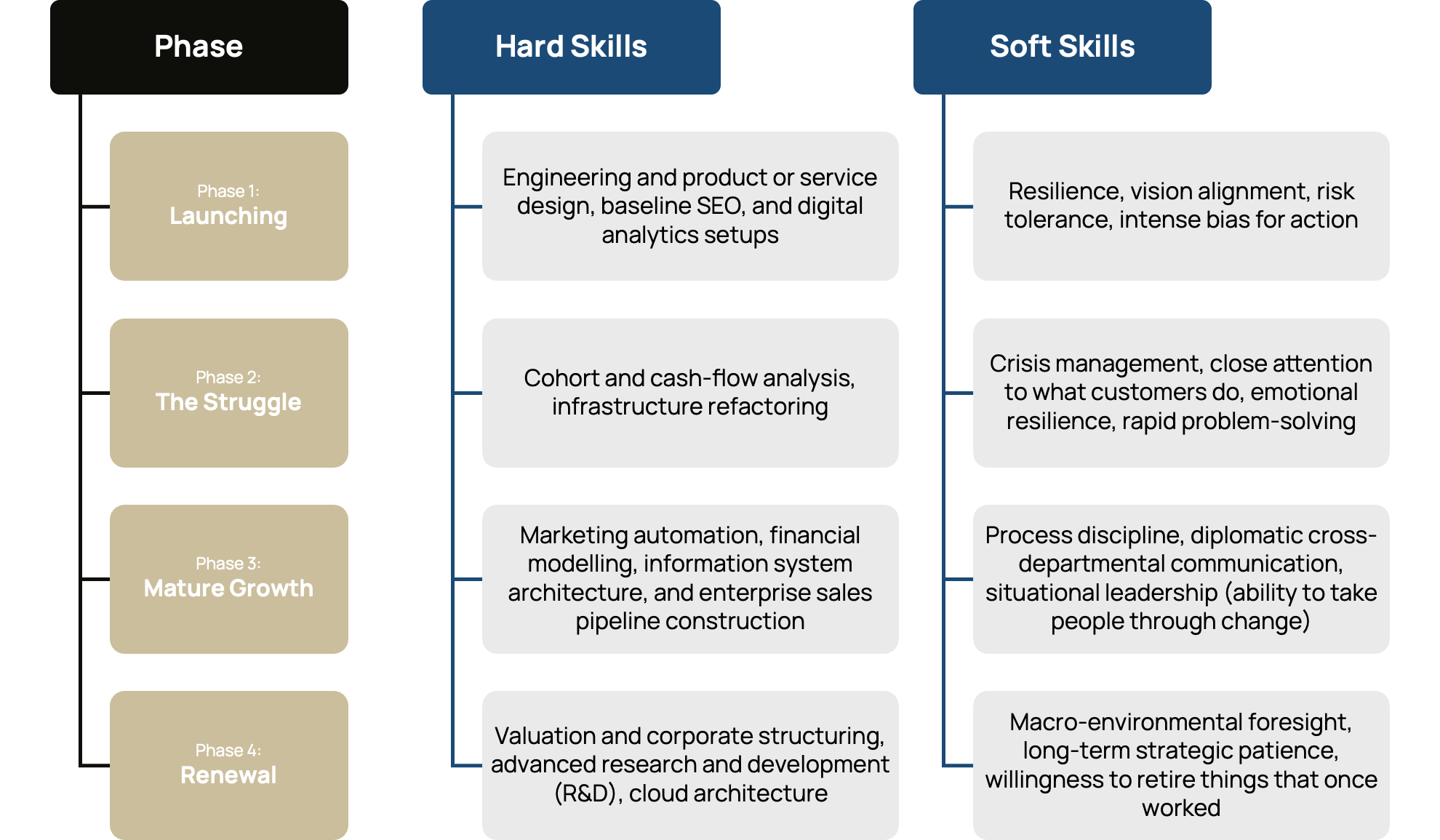
Each phase calls for a different sort of person: the builder, the diagnostician, the systems architect, the allocator of capital. A founder might bring the previous phase’s strengths to the present phase’s problem. They might build harder when the business needs an honest audit or tighten operations when it needs reinvention.
The phases can be understood by the hard and soft skills demanded of top management. We summarise these in Figure 2.
Figure 2. Hard and soft skills for each business phase.
The cycle repeats, with bigger numbers
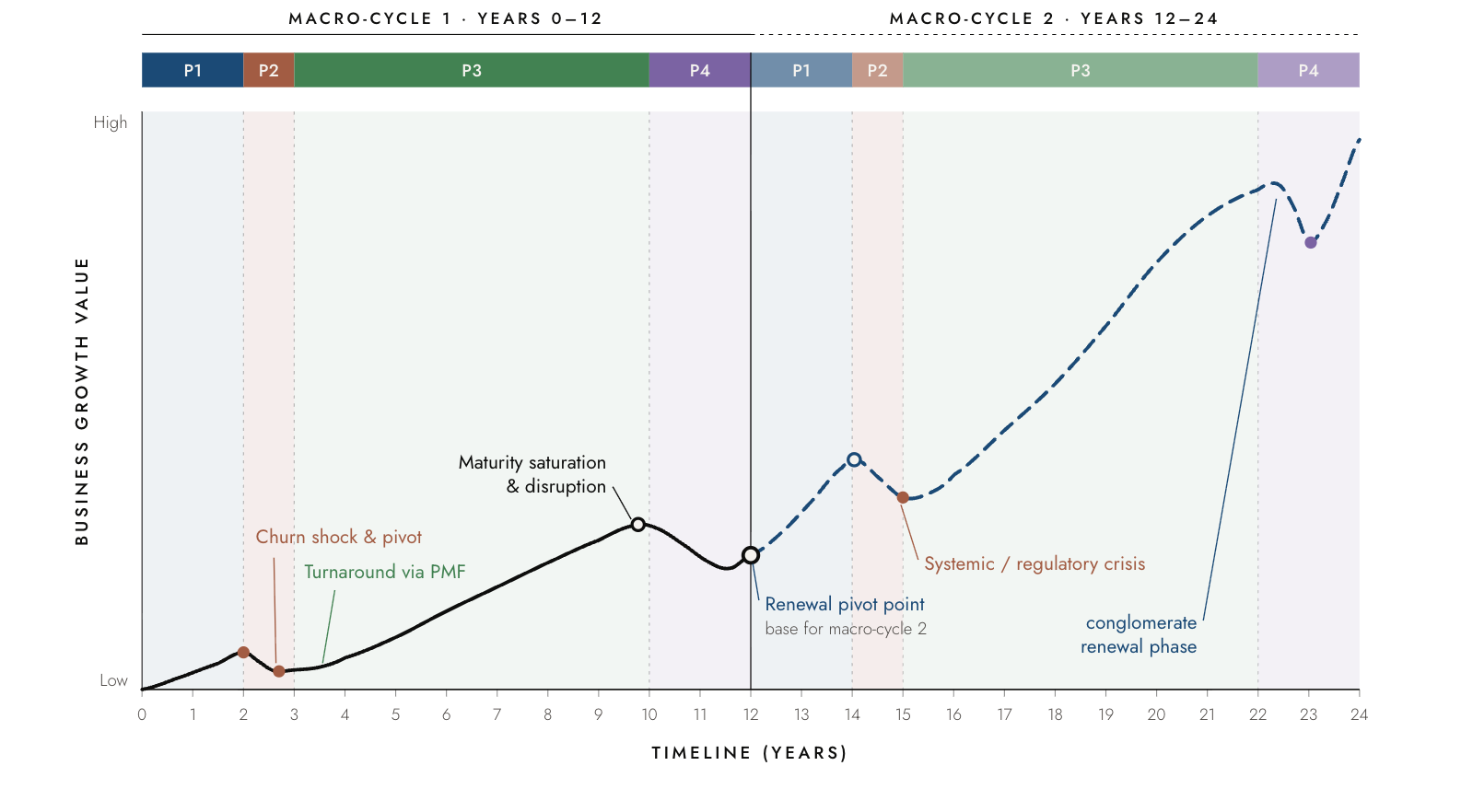
A successful renewal does not close the story. It begins the four phases again with the variables enlarged. One product becomes a portfolio. One market becomes several. Twenty people become hundreds or more. The problems change character: regulatory exposure, currency risk, the weight of internal complexity.
The shape holds, though — launch, struggle, compound, renew, at higher stakes and with more sophisticated instruments, but recognisably the same curve. This second curve is visualised in Figure 3.
Figure 3. 24-year multi-cycle growth trajectory.

Founder and CEO of SMCSE Solutions (Private) Limited and Chief Trainer at WISE. Area of expertise is entrepreneurial and managerial economics.

Editor-in-chief of Effective Thoughts | Chief Information Officer at SMCSE Solutions (Pvt.) Ltd. | Global UGRAD Alumnus - University of Southern Indiana | Graduate of Economics with Data Science at Information Technology University.