
Anyone who has done applied work knows the rhythm. Weeks hunting for data. Days cleaning it. Late nights fixing code that refuses to run. Then, if you are lucky, a few hours of real thinking. This week I watched a machine squeeze the first three stages into little more than an hour. I was impressed, and honestly a little shaken. So I went back to what economists know about technology and jobs. The research gives a clearer answer than the headlines to the question my colleagues and students keep asking me: will AI take our jobs?
A lecture, a conference and 83 minutes
Two events in the same week set this off. On the morning of 4 November 2026, from 9:00 to 10:30, Dr. Imran Khan of The Urban Unit, Lahore, came to ITU to give my Econometrics students a guest lecture, R for Economists. His most memorable point had little to do with R. You can now ask an AI assistant such as Claude, he told them, to fetch the data, run the estimation, draw the graphs and write the interpretation. In practice, it can do a complete thesis. I was not sure whether my students should feel excited or worried. Neither was I.
The day before, at the invitation of Prof. Nasra M. Shah, I had attended the opening of CIMRAD’s international conference on the future drivers of migration from Asia at the Lahore School of Economics on 3–4 November 2026. In her opening remarks, she announced that the organisers plan an edited book from the conference. As the sessions went on, I noticed something missing. Nobody had put the main sending countries side by side in one econometric model of what drives labour emigration, or asked where those flows are heading.
So I tested Dr. Khan’s claim on that gap. I asked an AI assistant to help me draft a chapter for the book covering Bangladesh, India, Nepal, Pakistan, Sri Lanka and the Philippines. In 1 hour and 23 minutes, it gathered official outflow data for 2005–2024, wrote and ran the R code, estimated Pooled Mean Group panel models, checked its forecasts against 2025 outcomes, projected flows to 2030 and wrote up the results with figures and references. Not long ago I would have set aside several weeks for that. Dr. Khan was right.
Those 83 minutes hit me hard, because I remember what computing used to cost. For my PhD in econometrics at PIDE, I compared Bayesian and frequentist estimators of GARCH models by simulation. A single run of a thousand iterations took about nine days of non-stop computing.
I had taught myself R, and Dr. Ijaz of Quaid-i-Azam University helped me improve. Then I made repeated journeys from Islamabad to Peshawar to learn from Dr. Roshan Ali at Khyber Medical University, a computational biologist who works in R. His teaching brought the run down to about 20 hours on a Core i3 and 11 hours on a Core i7. Even then, I needed more machines. Dr. Zafar Mahmood let me use a computer lab at NUST, and PIDE’s IT department gave me a whole lab of 20 computers for three or four days.
The two projects are not the same, and neither are their methods. But the contrast in effort is real. Back then, a single coding shortcut cost me a year and a half, many journeys and the generosity of three institutions. This week, I did not have to learn any shortcut at all. The machine wrote the code itself.
The draft still needs careful human review, as any first draft does. But look at who did what. The machine handled the execution: data, code, estimation, figures and prose. The research question came from a person sitting in a conference hall, listening for what others had not said. If AI can do nearly everything else, what exactly is an applied econometrician for? Economics has a surprisingly precise answer.
Jobs are bundles of tasks
Labour economists stopped asking whether machines replace jobs about twenty years ago. Since Autor, Levy and Murnane (2003), we think in tasks. A job is a bundle of tasks. Technology takes over some of them, leaves others alone and creates new ones.
Acemoglu and Restrepo (2019) sharpen this. Automation has a displacement effect: machines take over tasks people used to do, and demand for that labour falls. It also has a reinstatement effect: it creates new tasks in which labour has a comparative advantage, and demand rises again. Whether a profession shrinks or grows depends on which effect wins.
Look at your own working week through this lens. Finding data, cleaning it, writing code and formatting tables are being displaced. Checking AI output, designing studies and explaining results to decision-makers are growing. The figure below is my rough sketch of how the time might shift.
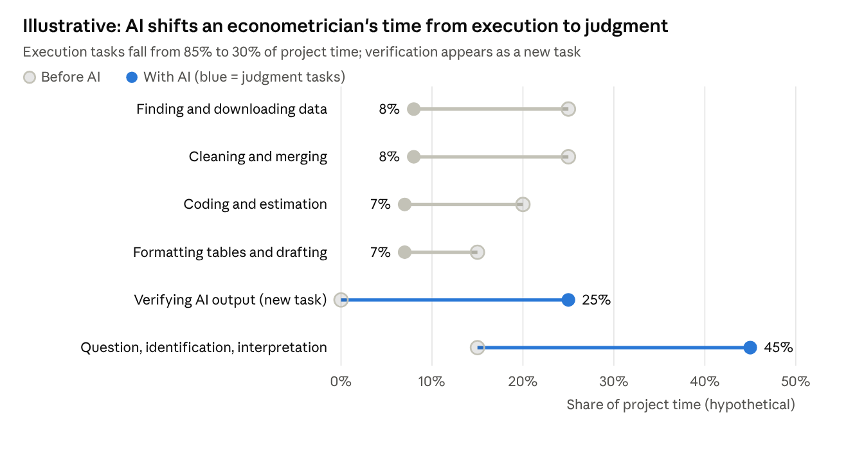
The job survives if the new tasks are worth paying for. If 85% of your project time goes on execution, most of your job is exposed. If most of it already goes on judgment, AI mainly hands you more time for the part that matters.
The jagged frontier: why AI is confidently wrong
So what can AI still not do well? The philosopher Michael Polanyi put it neatly: “we can know more than we can tell.” Much of what experienced econometricians know is tacit. It is the feeling that a number looks wrong, that a particular official series has never been reliable, that two variables move together only because both trend upward. Nobody writes this down, so a machine trained on text has little to learn it from.
A field experiment with 758 consultants at Boston Consulting Group gave this a name: the jagged technological frontier. AI is brilliant at some tasks and poor at others, and the line between them is rarely where you expect. On tasks inside the frontier, consultants using GPT-4 completed 12.2% more tasks, worked 25.1% faster and produced more than 40% higher-quality work. On a task chosen to sit just outside it, those using AI were 19 percentage points less likely to reach the correct answer. Worse, their wrong answers were rated as more coherent and persuasive.
Every econometrician knows the nightmare version: a beautifully formatted table, stars on every coefficient, built on a broken variable. The frontier is most jagged exactly where applied work is hardest: data credibility, identification and interpretation. Knowing where that edge lies is now a skill in its own right.
Substitute or complement?
Early evidence on generative AI at work contains a warning for junior analysts. Among 5,179 customer-support agents, an AI assistant raised productivity by 14% on average, including 34% for novice and low-skilled workers, with minimal impact on the most experienced. In a writing experiment with 453 professionals, ChatGPT cut the time taken by 40% and raised quality by 18%, while inequality between workers decreased. AI is a great leveller of codified skill. If your main edge as a young economist is fluency in Stata or R, that edge is shrinking fast.
Making the routine work easy raises the stakes on judgment. Michael Kremer’s (1993) O-ring theory explains why. It is named after the small rubber seal whose failure destroyed the space shuttle Challenger. When output depends on every link in a chain working, improving most links makes the weakest one decisive. If AI makes data collection, coding and drafting nearly flawless, a project now stands or falls on whether the question, the identification and the data are right. Judgment becomes the bottleneck, and bottlenecks get paid more.
With strong judgment, AI multiplies what an econometrician can do. With weak judgment, it can make things worse, producing results that are polished, persuasive and wrong, just like the consultants outside the frontier. There is also a reason for optimism on the demand side. When something becomes much cheaper, people often buy far more of it. If governments, donors and firms want more evidence once it is cheaper to produce, we could see more policy evaluations, more impact studies and more questions answered. That means more work for people who can tell good evidence from bad.
What about the universities?
My students ask a sharper version of the question: if AI can do a thesis, will universities still hire economists? The early signs are mixed. Universities are still hiring, but some departments are closing, and so far the cause is enrolment more than AI. In October 2025, the University of Peshawar shut nine BS programmes because too few students applied. Statistics was one of them, with seven applicants against a minimum of 15. In the United States, the University of Nebraska Board of Regents voted 7–1 in December 2025 to eliminate the statistics department at its Lincoln campus.
Faculty jobs follow student demand, and students follow perceived job prospects. If statistics and economics start to look like AI’s territory, applicants will drift to programmes with “AI” in the name, even when the content overlaps.
My bigger worry is how we decide whom to hire and promote. Pakistan’s criteria are built on counts. An Associate Professor needs 10 publications in HEC-recognised journals, 4 of them in the last five years, and a Professor needs 15. Counting made sense when every paper took months of work. It makes far less sense when a plausible paper can be produced in an afternoon.
The evidence is already alarming. One estimate reported by IEEE Spectrum suggests that by 2025, 57% of published articles showed detectable LLM influence, yet only one in forty such papers disclosed it. A journal editor writing in Times Higher Education described more than 20 submissions that were AI rewrites of published studies; they scored lower on plagiarism checks than genuine papers. An audit reported in Nature found nearly 3,000 biomedical papers citing references that do not exist, with the rate rising steeply since 2023. Even citation profiles can be inflated, as the epidemiologist Suneth Agampodi has shown for Google Scholar and ResearchGate.
This is Goodhart’s law at work: once a measure becomes a target, it stops being a good measure. When publication counts are cheap to produce, they stop telling us who can do research, and they quietly punish the honest researcher who writes three careful papers instead of fifteen fast ones.
Hiring committees will have to rely on what AI cannot fake: a seminar where candidates defend their own work, a teaching demonstration, replication files that actually run, grants won and genuine partnerships with institutions that hold data. For honest applied econometricians, that shift would be good news.
What this means for my classroom
I cannot ban AI from my students’ work, and I do not want to. But once every student can produce a polished report with the same tools, the report alone no longer tells me who understands econometrics and who does not. I would have no fair way to compare them. So I have decided to change what I assess, starting with my own courses and supervision.
- More defense, less submission. Every thesis and major project will end with an oral examination in which the student explains each modelling choice.
- Critique before production. Assignments will start from an AI-generated analysis and ask students to find what is wrong with it: the weak instrument, the trending series, the implausible number.
- Checkpoints, not just deadlines. Students will show me the question, the data choices and the identification strategy, in their own words, before any final draft exists.
- Disclosure as routine. Students will state which tools they used and for what, as I do at the end of this article.
Dr. Khan is right that AI can produce a thesis. My job is to make sure my students can defend one.
What I tell my students to learn
If I had to give my students one rule, it would be this: invest in the tasks that complement AI, not the ones it replaces.
First, learn identification, not just estimation. Any assistant can run IV, PMG or difference-in-differences. Very few people can convince a skeptical referee that an estimate is causal.
Second, get close to data that cannot be downloaded. Public data is no advantage once a machine can fetch it in seconds. Administrative records, restricted microdata and your own surveys depend on permission and trust, and people build those.
Third, know how things actually work on the ground: how a labour force survey is fielded, how a ministry really makes decisions. This kind of knowledge sits right outside the jagged frontier.
Fourth, treat checking as a craft. Match every number to its source, re-estimate in a second package and try the specification that might break your result. Think of AI as a fast, tireless research assistant who sometimes makes things up.
Fifth, learn to explain and defend. Policymakers need someone who can stand in a room, answer hard questions and take responsibility for the result.
And sixth, ask better questions. When answers are cheap, a question worth answering becomes the scarcest thing in research.
From technician to editor-in-chief
The economics of automation does not promise that every econometrician will be fine. It says something more specific: your value depends on which side of the task boundary you stand. Those who sell execution, such as cleaning, coding and formatting, face displacement. Those who sell judgment, such as framing, checking, interpreting and persuading, have just been given a tireless research team.
For economists in Pakistan and other developing countries, this may be the biggest opportunity of our careers. Tools that once needed a well-funded research group now run on one laptop. What is scarce now is good questions, trustworthy data, local knowledge and the honesty to say when a result is not good enough.
I may be underestimating the machines. The frontier moves every few months, and next year’s tools may spot research gaps too. Even then, one thing does not move with capability: someone has to put their name on the result and answer for it.
So where do I come down, after watching a machine draft a book chapter in 83 minutes? On two convictions. First, AI cannot think. It retrieves, computes, summarises and writes at astonishing speed. But it did not sit in that conference hall and notice what was missing, it did not choose the question, and it has no idea which of its own results matter.
Second, the final document has to be defended by a person. A thesis, a chapter or a policy report is not finished when the text is written. It is finished when someone stands behind it. When a referee attacks the identification, when a viva committee asks why this model and not another, when a ministry asks whether it can act on a forecast, no AI will be sitting in that chair. The author will. If you cannot explain and defend every table in your document, you have not really written it, whatever tool produced the words.
The question is not whether AI will take our jobs. It is whether we are doing the part of the job that only we can do.
Transparency note: The migration chapter described here and the first draft of this article were prepared with the help of Claude, an AI model by Anthropic. The figure in this article is an illustrative sketch, not an estimate. All results and interpretations were reviewed by the author, who takes full responsibility for them.
Sources
Acemoglu, D. and Restrepo, P. (2019). Automation and new tasks: How technology displaces and reinstates labor. Journal of Economic Perspectives, 33(2), 3–30.
Agampodi, S. (2025, 8 February). Gaming the H-index: The dark side of Google Scholar and ResearchGate. LinkedIn.
Amstat News (2026, 1 January). University of Nebraska Regents vote to eliminate statistics department. American Statistical Association.
Ashfaq, M. (2025, 27 October). Peshawar university shuts nine departments over low enrolment. Dawn.
Autor, D. H., Levy, F. and Murnane, R. J. (2003). The skill content of recent technological change: An empirical exploration. Quarterly Journal of Economics, 118(4), 1279–1333.
Brynjolfsson, E., Li, D. and Raymond, L. (2025). Generative AI at work. Quarterly Journal of Economics, 140(2), 889–942.
Dell’Acqua, F. et al. (2023). Navigating the jagged technological frontier. Harvard Business School Working Paper 24-013.
Higher Education Commission, Pakistan. Faculty appointment criteria.
Hong, S. (2025, 14 August). AI-based fake papers are a new threat to academic publishing. Times Higher Education.
Kremer, M. (1993). The O-ring theory of economic development. Quarterly Journal of Economics, 108(3), 551–575.
Naddaf, M. (2026, 8 May). Surge in fake citations uncovered by audit of 2.5 million biomedical-science papers. Nature.
Noy, S. and Zhang, W. (2023). Experimental evidence on the productivity effects of generative artificial intelligence. Science, 381(6654), 187–192.
Polanyi, M. (1966). The Tacit Dimension. Chicago: University of Chicago Press.
Skuse, B. (2026, 27 October). I used AI to fake a scientific paper. Here’s what happened. IEEE Spectrum.

Dr. Farrukh Mahmood is an econometrician whose work sits at the intersection of economic theory, econometric specification and data visualisation. He believes models should be diagnosed from the data, not imposed by convention, and applies this to labour markets, migration, monetary dynamics and development in Pakistan. He is Assistant Professor and Chairperson of the Department of Economics at Information Technology University (ITU), Lahore, and holds a PhD in Econometrics from PIDE.