
Feelings due to hurt or betrayal often grow into distrust or anger, then pessimism, and finally, cynicism. Anger, pessimism, and cynicism form a highly destructive psychological triad that actively chokes normal living and financial prosperity, and paralyses personal, professional, and strategic development. When these three forces lock together, they form a toxic feedback loop that completely paralyzes an individual’s growth mindset or organization’s growth trajectory and strangles financial cash flow, personal and institutional.
Contagious Triangle: The Structural Blueprint
Mindsets are not isolated thoughts; they are contagious emotional states. Because of mirror neurons in the human brain, the emotional energy one carries is unconsciously picked up and mimicked by clients, investors, partners, and employees.
- Anger (The Cause): Anger is born from unmet expectations, perceived injustices, or past failures. Anger makes an individual reactive rather than assertive. In business, anger manifests impatience, blame, and a volatile temperament of leaders/managers, so it repels high-value clients and talent. Anger acts as the emotional catalyst. When anger is left unmanaged, it ceases to be a temporary emotional state and solidifies into a permanent defensive posture such as pessimism or cynicism.
- Pessimism (The Blockade): Pessimism is the intellectualization of anger. Pessimism is the fatalistic belief that the future will yield negative outcomes, regardless of effort. It acts as a blockade, convincing the individual that trying new strategies, investing capital, or learning new skills is entirely pointless.
- Cynicism (The Blind Ally): Cynicism is the generalized intellectualization of pessimism. It assumes that everyone has an ulterior motive, that systems are rigged, and that collaboration is a trap. This deep-seated distrust destroys the growth mindset and relational capital needed to shape growth or to build business.
Symbiotic Mechanics: How Dynamics Work
The trio of anger, cynicism, and pessimism forms a psychological closed loop known as the Toxic Contagious Triangle. The true risk of this triangle lies in its self-sustaining and overwhelming nature. One corner naturally breeds the next:
Step 1: ANGER → generates → PESSIMISM
Step 2: PESSIMISM → hardens into → CYNICISM or FATAL BELIEFS
Step 3: CYNICISM → shapes Tunnel Vision (TV) → TV provokes → ANGER
This is visualized in Figure 1.
Figure 1. The toxic contagious triangle
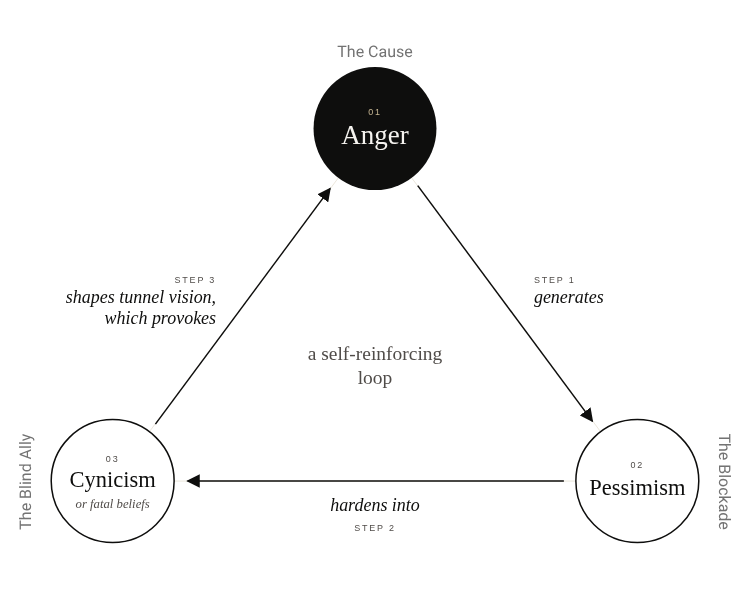
This cycle is labelled contagious because it is highly transmissible. In a corporate or team environment, a single leader trapped in this triangle can infect an entire sphere. Negativity spreads quickly because it masquerades as realistic critical thinking or survival wisdom.
Suppression of the Growth Mindset – Some Aftermaths
To understand how this triangle stops cash flow and business growth, we must look at the direct mechanical links between psychology and economic output. Carol Dweck’s concept of a growth mindset relies on the belief that abilities, intelligences, and financial status can be developed through hard work, repetition or routines, and dedication. A growth mindset embraces challenges as opportunities or failures as lessons to grow. Within the toxic contagious triangle, a challenge looks like a trap set by a rigged system or failure a fate. The Scarcity Triangle fundamentally breaks the healthy beliefs:
- Anger consumes the cognitive bandwidth required for neuroplasticity and strategic reflection, keeping the brain in a constant, short-sighted “fight-or-flight” survival mode. Rather than using issue or criticism to adjust a leadership style and business model, anger interprets occurrence or feedback as a personal insult, prompting an immediate defensive reaction.
- Pessimism tells you that failure is permanent and pervasive, neutralizing the willingness to learn. Growth requires sustained, focused effort. Pessimism tells you that effort is futile because the macroeconomy or your industry is fundamentally broken. Work-related pessimism is also associated with about 60% loss in productivity.
- Cynicism tells you that those who succeed only do so through luck or corruption, neutralizing successful inspirations or timeless cannons. For a growth-oriented entrepreneur, a failed action is just new data to make better future decisions; conversely, for someone trapped in the triangle, it is permanent proof that they were right to doubt the venture from the beginning.
Destruction of Cash Flow/Business Growth – Impact Matrix
Cash flow is the lifeblood of any commercial operation or individual portfolio. It requires active movement, transactional trust, and risk calculation. We map these three forces onto a Psychological-Financial Impact Matrix. This matrix crosses the Internal Emotional State against External Economic Action, revealing the exact mechanism of financial decay:
| Toxic Vertex | Behavioral Expression | Economic Impact |
|---|---|---|
| Anger | Emotional volatility, combative negotiations, impulsive and short-sighted decision-making, and burning connections with partners. | Destroys Relationships: Clients leave for calmer vendors; top talent resigns, skyrocketing turnover costs. |
| Pessimism | Severe risk-aversion, refusing to market dynamics, hesitation to pitch high-value clients, and treating cash as a safety blanket. | Kills Investment: Capital sits stagnant in low-yield areas steadily eroding due to inflation instead of funding expansion or diversification. Saying “no” to lucrative partnerships. |
| Cynicism | Paralyzing distrust, endless contractual delays, and hoarding information. | Strangles Momentum: Opportunities are lost to competitors while you spend weeks/months on over-analyzing basic good-faith deals. Refusing to collaborate or delegate. Micro-managing teams. |
By proactively monitoring your position on the Impact Matrix, you hopefully can reset these contagious traits with due diligence. Swapping them for empathy and assertiveness, curiosity and creativity, and professional and strategic optimism, shifts your focus from protecting a shrinking pie to actively expanding your financial horizon, personal and institutional.
Path to Freedom – Breaking the Triangle
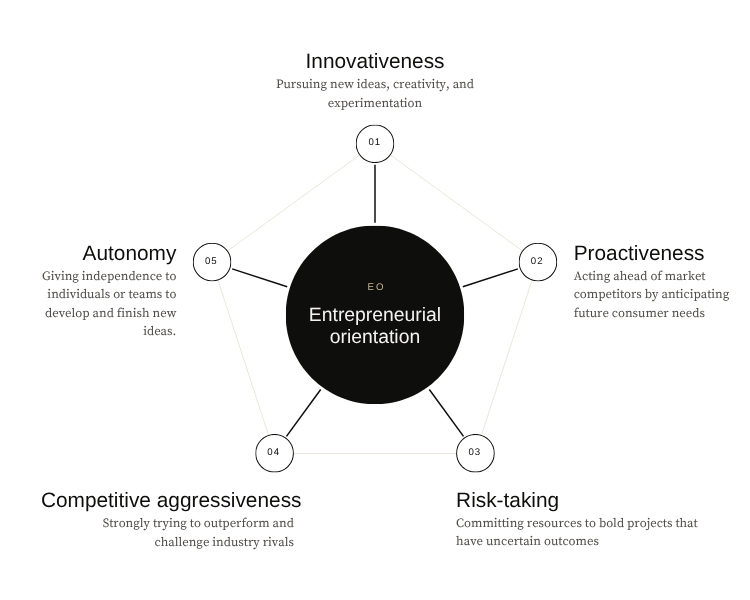
Entrepreneurial Orientation (EO) is vital framework to break or dismantle the toxic triangle. Entrepreneurial orientation (EO) is the mental construct, management style, and decision-making practice that a company/leadership uses to act entrepreneurially and pursue new opportunities for success and performance.
EO has five components such as Innovativeness (pursuing new ideas, creativity, and experimentation, such as investing in research and development, R&D), Proactiveness (acting ahead of market competitors by anticipating future consumer needs and securing first-mover advantages), Risk-Taking (committing major resources to bold projects that have uncertain outcomes), Competitive Aggressiveness (strongly trying to outperform and challenge industry rivals), and Autonomy (applying autonomy and giving independence to individuals or teams to develop and finish new ideas without heavy corporate rules).
Figure 2. Entrepreneurial Orientation (EO) rests on five components
It is noteworthy that EO framework is dynamically connected with Total Quality Management (TQM) practices of institutions. While they may seem opposite—EO pushes for radical changes that can disrupt processes, while TQM strives for stability and standardization—they actually balance each other out in successful/performing organizations through professional and strategic acts of leaders.
To reverse this contagion and deadly loop, the toxic triangle must be systematically dismantled with EO/TQM Frameworks and replace them with its counterforces: Empathy or assertive boundaries, Professional or Strategic Optimism, and Curiosity & Creativity.
Shift Anger to Empathy/Boundary: Anger is an erratic reaction to a perceived boundary violation. Instead of letting frustration build up into an emotional outburst. Establish clear, objective boundaries in your job contracts, client agreements, and work schedules. When clear rules govern your professional relationships, the need for emotional defensiveness disappears.
For example, when a deal fails or a client leaves, swap anger for empathy or boundary. Ask, “What pressure is my client facing that caused this?” This shifts the brain from a defensive posture to a problem-solving mode, preserving relationships and/or opening alternative revenue streams.
Shift Pessimism to Professional/Strategic Optimism: Professional/Strategic optimism is not blind or toxic positivity. It is the unwavering belief that a positive outcome is achievable, paired with a realistic, actionable plan to get there. It gives you the psychological runway to invest capital, pitch bigger clients, and resist economic downturns without freezing assets.
Professional/Strategic optimism does not mean ignoring market risks; it means treating setbacks as temporary, localized, and fixable problems. Build robust contingency plans to safeguard operations, but keep your primary focus on execution, innovation, and long-term value creation.
Shift Cynicism to Curiosity & Creativity: Instead of assuming a new market trend or a competitor’s strategy is a scam, approach it with pure curiosity. Ask, “What do they see that I don’t see yet?” Curiosity is the foundational engine of a growth mindset; it reveals hidden market gaps and uncovers new monetization strategies. Instead of assuming a client or competitor or investor has malicious intent, approach unfamiliar situations with curiosity and creativity.
Ask open-ended questions: “What problem are they trying to solve?” or “What market pressure is driving this behavior?” Shifting from judgment to objective investigation neutralizes toxic suspicion while revealing hidden market opportunities.
Conclusion
The Contagious Triangle of anger, pessimism, and cynicism creates a powerful psychological prison. It tricks the mind into treating fear as wisdom and stagnation as business safety. By recognizing this loop early, one can consciously choose to replace it with a framework of clear boundaries, curiosity and creativity, and calculated optimism. This cognitive shift is what reopens the door to a healthy growth mindset and restores the natural momentum of cash flow and business growth.
EO (Entrepreneurial Orientation) and TQM (Total Quality Management) are two distinct but strategically linked management frameworks that entrepreneurs/businesses use to realize success, drive performance, and stabilize growth. EO focuses on external market opportunities and risk-taking. TQM focuses on internal process improvement, leadership style, and customer satisfaction.
REFERNCES
Britannica, T. Editors of Encyclopaedia and Costa, D. (2026). Entrepreneurship. Encyclopedia Britannica.
Christ, G. (2025). Worker pessimism, uncertainty and disconnect reach ‘critical levels,’ survey finds. HR Dive.
Dweck, C. S., & Yeager, D. S. (2019). Mindsets: A View From Two Eras. Perspectives on Psychological Science, 14(3), 481-496.
Glancey, K. S., & McQuaid, R. W. (2000). Entrepreneurial economics (J. Campling, Ed.). Palgrave Macmillan UK.
Goleman, D. P. (1995). Emotional intelligence: Why it can matter more than IQ. New York: Bantam Books.
Hutchison, B. (2023). Cynicism Can Be Toxic and Sometimes Fatal. Psychology Today
Kaplan, S. (2026). Harvard Research Suggests Pessimism Is Bad for Business. Inc.
Lumpkin, G. T., & Dess, G. G. (1996). Clarifying the Entrepreneurial Orientation Construct and Linking It to Performance. The Academy of Management Review, 21(1), 135–172.
Oxford Languages. (n.d.). Anger/Pessimism/Cynicism. In Oxford English Dictionary.
Sebanz, N., Knoblich, G. (2014). Mirror neuron. Encyclopedia Britannica.

Founder and CEO of SMCSE Solutions (Private) Limited and Chief Trainer at WISE. Area of expertise is entrepreneurial and managerial economics.